

The Rise of AI-Powered Executive Decision Systems
Enterprise leadership is entering a historic transformation. For decades, executive decision-making relied heavily on human judgment, fragmented data interpretation, historical analysis, and hierarchical governance models. While these approaches shaped industrial and digital-era corporations, the accelerating complexity of the modern economy is exposing their limitations.
Today’s enterprises operate in environments defined by:
- Artificial intelligence acceleration
- Real-time market volatility
- Geopolitical instability
- Massive data proliferation
- Digital disruption
- Hyperconnected global ecosystems
- Cybersecurity threats
- Rapid technological innovation
- Continuous operational complexity
Traditional executive decision frameworks are increasingly unable to process the speed, scale, and complexity of modern enterprise dynamics.
As a result, organizations are rapidly adopting AI-powered executive decision systems.
These systems combine artificial intelligence, predictive analytics, enterprise intelligence, machine learning, strategic foresight, and adaptive governance into integrated leadership architectures capable of improving executive decision-making at scale.
AI-powered executive decision systems are fundamentally reshaping:
- Enterprise governance
- Strategic planning
- Risk management
- Operational execution
- Leadership intelligence
- Innovation systems
- Resource allocation
- Workforce management
- Competitive strategy
Organizations that successfully integrate AI-powered decision architectures are creating major competitive advantages through faster decision velocity, improved strategic precision, enterprise adaptability, and intelligent operational orchestration.
This article explores the rise of AI-powered executive decision systems, how they work, their impact on enterprise governance and strategy, and why intelligent decision architectures are becoming foundational to the future enterprise. It includes:
AI-powered governance frameworks, Executive intelligence architectures, Predictive decision systems, Strategic AI integration models, Intelligent enterprise operating systems, AI governance and ethical leadership, Human-AI collaboration frameworks, Future enterprise governance trends, and FAQ schema-ready content.
What Are AI-Powered Executive Decision Systems?
AI-powered executive decision systems are integrated enterprise intelligence frameworks that use artificial intelligence, machine learning, predictive analytics, and real-time data systems to support strategic leadership and executive governance.
These systems help executives:
- Analyze complex enterprise data
- Predict market outcomes
- Simulate strategic scenarios
- Optimize operational decisions
- Identify emerging risks
- Improve resource allocation
- Enhance governance oversight
- Accelerate strategic execution
Unlike traditional business intelligence platforms that primarily report historical information, AI-powered executive systems continuously generate predictive and adaptive insights.
They evolve from passive reporting systems into active strategic intelligence architectures.
Why AI-Powered Decision Systems Are Rising
Several global forces are accelerating the rise of intelligent executive systems.
1. Enterprise Complexity Is Increasing
Modern enterprises manage:
- Global operations
- Distributed workforces
- Digital ecosystems
- Multi-market competition
- Massive data environments
- Regulatory complexity
- Supply chain volatility
- Cybersecurity exposure
Human cognitive capacity alone is increasingly insufficient for processing enterprise-scale complexity.
AI-powered systems augment leadership intelligence.
2. Speed Has Become a Competitive Advantage
Decision speed now directly impacts:
- Market responsiveness
- Innovation velocity
- Operational agility
- Customer experience
- Competitive positioning
Organizations capable of making faster, higher-quality strategic decisions gain significant market advantages.
AI systems improve decision velocity through:
- Real-time analytics
- Predictive forecasting
- Automated intelligence generation
- Intelligent scenario modeling
3. Data Has Become a Strategic Asset
Enterprises generate enormous volumes of data across:
- Operations
- Customers
- Finance
- Supply chains
- Workforce systems
- Market intelligence
- Digital interactions
AI-powered executive systems convert enterprise data into strategic intelligence.
4. Predictive Governance Is Becoming Essential
Traditional governance models are reactive.
Modern enterprises increasingly require predictive governance systems capable of:
- Anticipating risks
- Monitoring enterprise health
- Detecting operational anomalies
- Identifying market shifts
- Supporting proactive intervention
AI enhances governance through continuous intelligence generation.
5. AI Infrastructure Is Maturing
Cloud computing, machine learning platforms, enterprise analytics systems, and generative AI technologies have significantly improved the scalability of intelligent enterprise systems.
Organizations now possess the technological infrastructure required to operationalize AI-powered executive architectures.
Core Components of AI-Powered Executive Decision Systems
Executive Intelligence Platforms
Executive intelligence platforms centralize enterprise insights into unified leadership dashboards.
These systems integrate:
- Financial intelligence
- Operational analytics
- Workforce insights
- Customer intelligence
- Risk diagnostics
- Market intelligence
- Strategic performance metrics
Executives gain enterprise-wide visibility in real time.
Predictive Analytics Systems
Predictive analytics systems use AI models to forecast:
- Market demand
- Operational disruptions
- Financial outcomes
- Customer behavior
- Workforce trends
- Competitive shifts
- Risk exposure
Predictive systems improve strategic preparedness.
AI-Driven Scenario Modeling
Scenario modeling systems simulate multiple strategic outcomes.
Organizations can evaluate:
- Expansion strategies
- Investment decisions
- Market disruptions
- Economic volatility
- Supply chain risks
- Competitive responses
Scenario intelligence improves executive foresight.
Intelligent Risk Management Systems
AI-powered risk systems continuously monitor:
- Financial risk
- Operational risk
- Cybersecurity threats
- Regulatory exposure
- Reputation risk
- Supply chain vulnerability
These systems improve enterprise resilience and governance capability.
Strategic Execution Systems
Execution intelligence systems track strategic initiatives in real time.
They help organizations:
- Monitor KPIs
- Identify bottlenecks
- Improve accountability
- Coordinate enterprise execution
- Optimize resource deployment
Execution visibility improves organizational performance.
AI Copilots for Executives
Generative AI and executive copilots increasingly assist leadership teams by:
- Summarizing enterprise intelligence
- Generating strategic recommendations
- Producing operational insights
- Supporting meeting analysis
- Accelerating information synthesis
- Improving decision preparation
AI copilots augment executive productivity and strategic responsiveness.
The Impact of AI-Powered Decision Systems on Enterprise Governance
From Reactive Governance to Predictive Governance
Traditional governance models often respond after problems emerge.
AI-powered governance systems shift enterprises toward predictive governance.
Organizations can proactively identify:
- Emerging risks
- Compliance vulnerabilities
- Operational inefficiencies
- Market threats
- Financial instability
This improves strategic resilience.
Enhanced Board-Level Intelligence
Boards increasingly require:
- Real-time enterprise visibility
- Risk intelligence
- Strategic forecasting
- ESG monitoring
- Performance diagnostics
- Digital transformation oversight
AI-powered governance systems provide deeper executive and board-level insights.
Data-Driven Strategic Accountability
Intelligent systems improve governance accountability by linking:
- Strategic objectives
- Operational performance
- Financial outcomes
- Leadership execution
- Workforce productivity
This creates measurable governance transparency.
Governance Automation
AI systems increasingly automate:
- Compliance monitoring
- Audit workflows
- Policy enforcement
- Risk reporting
- Regulatory tracking
Automation reduces operational inefficiencies while improving governance consistency.
AI-Powered Executive Systems and Enterprise Strategy
Strategic Foresight at Scale
AI improves strategic foresight through:
- Trend analysis
- Competitive intelligence
- Economic modeling
- Market prediction
- Consumer behavior forecasting
Organizations gain a stronger long-term planning capability.
Faster Strategic Adaptation
Modern markets evolve rapidly.
AI-powered systems help enterprises:
- Detect shifts early
- Reallocate resources dynamically
- Adjust strategy in real time
- Improve operational agility
- Accelerate innovation cycles
Adaptive strategy becomes a continuous enterprise capability.
Intelligent Capital Allocation
AI-powered systems optimize:
- Investment prioritization
- Resource deployment
- Operational spending
- Innovation funding
- Workforce planning
This improves enterprise efficiency and strategic ROI.
Competitive Intelligence Optimization
AI systems monitor:
- Competitor activity
- Industry trends
- Market disruptions
- Emerging technologies
- Consumer sentiment
Executives gain deeper strategic awareness.
Leadership Transformation in the AI Era
AI-powered executive systems are transforming leadership itself.
Future enterprise leaders will increasingly require capabilities in:
- AI governance
- Data intelligence
- Predictive strategy
- Human-AI collaboration
- Adaptive leadership
- Digital transformation
- Intelligent risk management
Leadership is evolving from intuition-driven management toward intelligence-driven enterprise orchestration.
Human Leadership Still Matters
Despite rapid AI advancement, executive leadership remains fundamentally human.
AI cannot replace:
- Ethical judgment
- Human empathy
- Organizational trust
- Cultural leadership
- Strategic vision
- Moral responsibility
- Stakeholder relationship management
The most successful enterprises will combine:
- Human leadership intelligence
- AI-driven enterprise systems
- Adaptive governance frameworks
- Ethical decision architectures
The future enterprise is not AI-led alone.
It is human-led and AI-augmented.
Challenges of AI-Powered Executive Decision Systems
Data Quality Risks
AI systems depend on accurate, high-quality data.
Poor data governance can produce:
- Faulty predictions
- Strategic errors
- Governance failures
- Operational inefficiencies
Organizations require robust data governance frameworks.
Ethical and Regulatory Concerns
AI-driven governance introduces challenges involving:
- Bias
- Privacy
- Transparency
- Accountability
- Regulatory compliance
- Explainability
Ethical governance systems are becoming increasingly critical.
Leadership Capability Gaps
Many executives lack advanced capabilities in:
- AI strategy
- Enterprise analytics
- Digital governance
- Intelligent systems management
Organizations must invest in executive capability transformation.
Organizational Resistance
AI adoption often creates workforce anxiety and leadership resistance.
Organizations need:
- Change management systems
- Workforce education
- Transparent communication
- Human-centered transformation strategies
The Future of AI-Powered Executive Decision Systems
The future enterprise will increasingly depend on intelligent decision architectures.
Key trends include:
Autonomous Strategic Intelligence
AI systems will continuously monitor enterprise environments and generate strategic recommendations in real time.
Intelligent Enterprise Operating Systems
Organizations will integrate governance, operations, intelligence, workforce systems, and strategy into unified AI-powered enterprise platforms.
Hyper-Personalized Executive Intelligence
Executives will receive customized strategic intelligence streams based on organizational priorities and leadership roles.
Human-AI Strategic Collaboration
Decision-making will become increasingly collaborative between executives and AI systems.
Predictive Enterprise Governance
Governance systems will evolve from reactive oversight to continuous predictive enterprise management.
AI-Powered Decision Systems as a Competitive Advantage
The enterprises dominating the next decade will likely be organizations capable of:
- Building intelligent leadership architectures
- Integrating AI into governance systems
- Scaling predictive intelligence
- Accelerating strategic execution
- Improving enterprise agility
- Enhancing organizational resilience
- Orchestrating adaptive operations
AI-powered executive systems create compounding advantages through:
- Faster decisions
- Smarter resource allocation
- Better strategic alignment
- Reduced operational risk
- Improved innovation capability
- Stronger governance transparency
These advantages become increasingly difficult for competitors to replicate.
Conclusion – AI-Powered Executive Decision Systems
AI-powered executive decision systems are fundamentally reshaping enterprise governance, strategic leadership, and organizational intelligence.
As global business complexity accelerates, traditional decision frameworks are becoming insufficient for managing modern enterprise environments.
Organizations now require intelligent leadership architectures capable of integrating:
- Artificial intelligence
- Predictive analytics
- Strategic foresight
- Enterprise intelligence
- Adaptive governance
- Operational execution
- Human-centered leadership
The future enterprise will not simply use AI tools.
It will operate through intelligent executive ecosystems that continuously optimize strategic coordination, governance oversight, innovation capability, and organizational adaptability.
The organizations that successfully integrate AI-powered executive decision systems today will define the next era of enterprise leadership, digital governance, and intelligent competitive advantage.
Frequently Asked Questions (FAQ) – AI-Powered Executive Decision Systems
What are AI-powered executive decision systems?
AI-powered executive decision systems are intelligent enterprise platforms that use artificial intelligence, predictive analytics, and enterprise data systems to support strategic leadership, governance, and executive decision-making.
Why are AI-powered executive decision systems important?
These systems improve decision speed, predictive accuracy, strategic alignment, governance visibility, operational efficiency, and enterprise adaptability.
How do AI-powered executive decision systems improve governance?
They enhance governance through predictive risk monitoring, compliance automation, enterprise intelligence, strategic accountability, and real-time operational visibility.
What technologies power executive decision systems?
Core technologies include artificial intelligence, machine learning, predictive analytics, enterprise intelligence platforms, cloud computing, data analytics, and generative AI systems.
Can AI replace executive leadership?
No. AI augments executive leadership by improving intelligence generation and decision support, but human leadership remains essential for ethical judgment, vision, culture, and stakeholder management.
What are the biggest challenges of AI-powered Executive Decision Systems governance?
Challenges include data quality risks, ethical concerns, regulatory compliance, organizational resistance, leadership capability gaps, and governance transparency.
What industries benefit most from AI-powered executive systems?
Industries benefiting include banking, healthcare, manufacturing, telecommunications, logistics, retail, energy, technology, education, and government.
What is the future of AI-powered executive leadership?
The future includes predictive governance, AI-augmented strategic planning, intelligent enterprise operating systems, human-AI collaboration, and adaptive executive intelligence architectures.
Call to Action
Build an AI-Powered Executive Decision System for the Future Enterprise
The speed, complexity, and volatility of the modern business environment demand a new generation of leadership architecture.
Organizations that continue relying solely on traditional decision-making models risk slower execution, fragmented governance, operational blind spots, and declining competitive relevance.
The future belongs to enterprises capable of integrating:
- AI-powered executive intelligence
- Predictive decision systems
- Intelligent governance frameworks
- Real-time strategic analytics
- Adaptive operational architectures
- Enterprise-wide data intelligence
- Human-AI strategic collaboration
- Intelligent execution ecosystems
If your organization is ready to:
- Accelerate executive decision-making
- Improve strategic foresight
- Strengthen governance and risk intelligence
- Scale enterprise agility
- Optimize operational performance
- Enhance leadership intelligence
- Modernize enterprise strategy systems
- Build future-ready executive infrastructures
Now is the time to develop AI-powered executive decision systems designed for intelligent enterprise leadership.
Transform leadership from reactive management into predictive enterprise orchestration powered by artificial intelligence, adaptive governance, strategic intelligence, and data-driven execution.
Choose between a Reengineered Strategic Brief or a Research Report URL Brief for Leadin+C AI™ to generate an enterprise-grade action plan aligned with your growth, execution, and market goals.
The next generation of market leaders will not simply use AI tools. They will operate intelligent executive ecosystems capable of continuously optimizing strategy, governance, innovation, and enterprise performance in the evolving AI economy.
Final Strategic Insight
AI-powered executive decision systems are becoming the foundational operating infrastructure of the intelligent enterprise. Organizations that integrate predictive intelligence, adaptive governance, AI-driven strategy, and human-centered leadership into unified executive architectures will shape the future of enterprise competitiveness, governance, and strategic leadership in the AI economy.
-
Previous Post
Leadership Intelligence for Digital Transformation
Post a comment
Related Posts
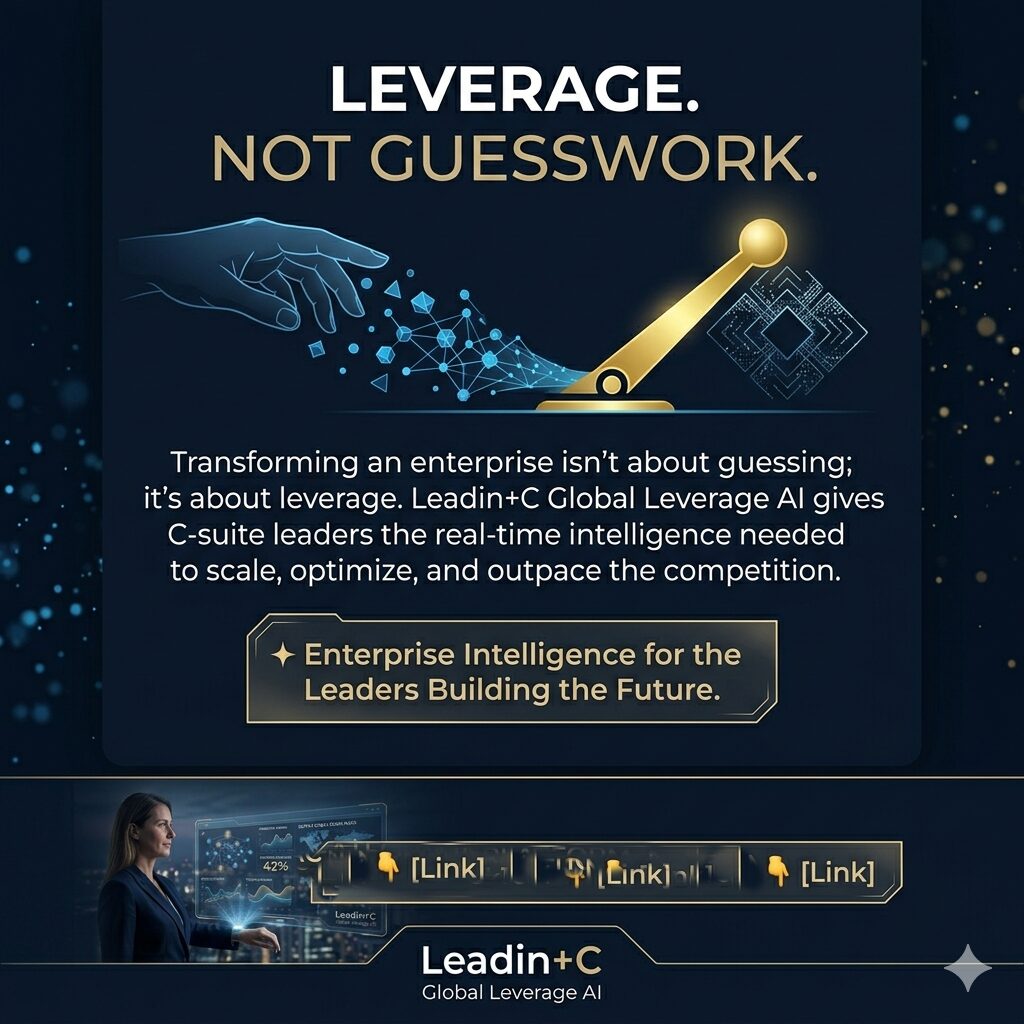
Leadin+C Global Leverage AI: AI-Driven Enterprise Transformation Review
AI-Driven Enterprise Transformation for Strategic Growth, Execution & Competitive Dominance